Relution Server 5.35
Relution version 5.35 focuses primarily on optimizations, improvements to the user experience, and bug fixes. In addition to technical refinements, existing functions have been further stabilized and processes simplified to make daily work with Relution even more efficient and intuitive.
Restoring older policy versions
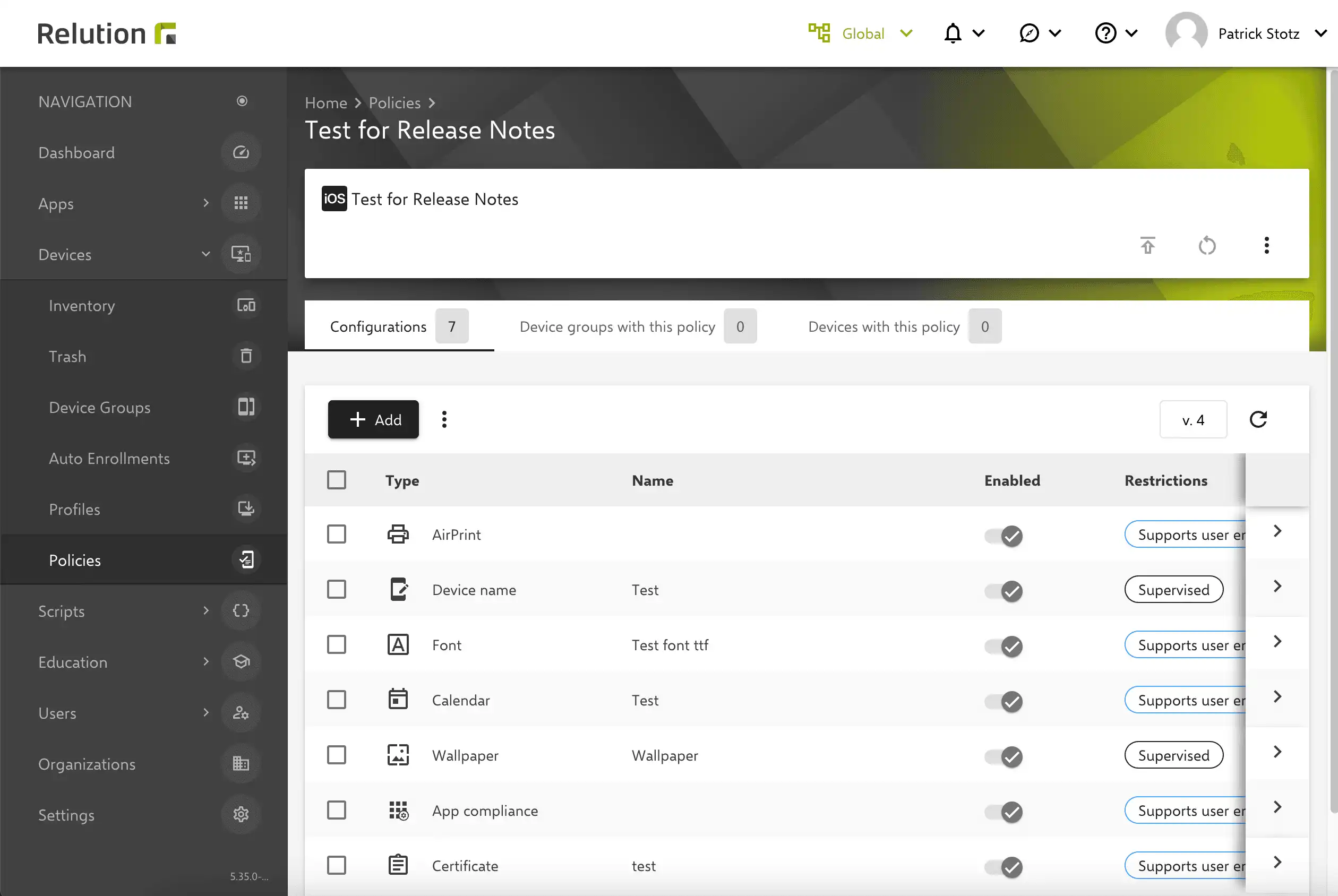
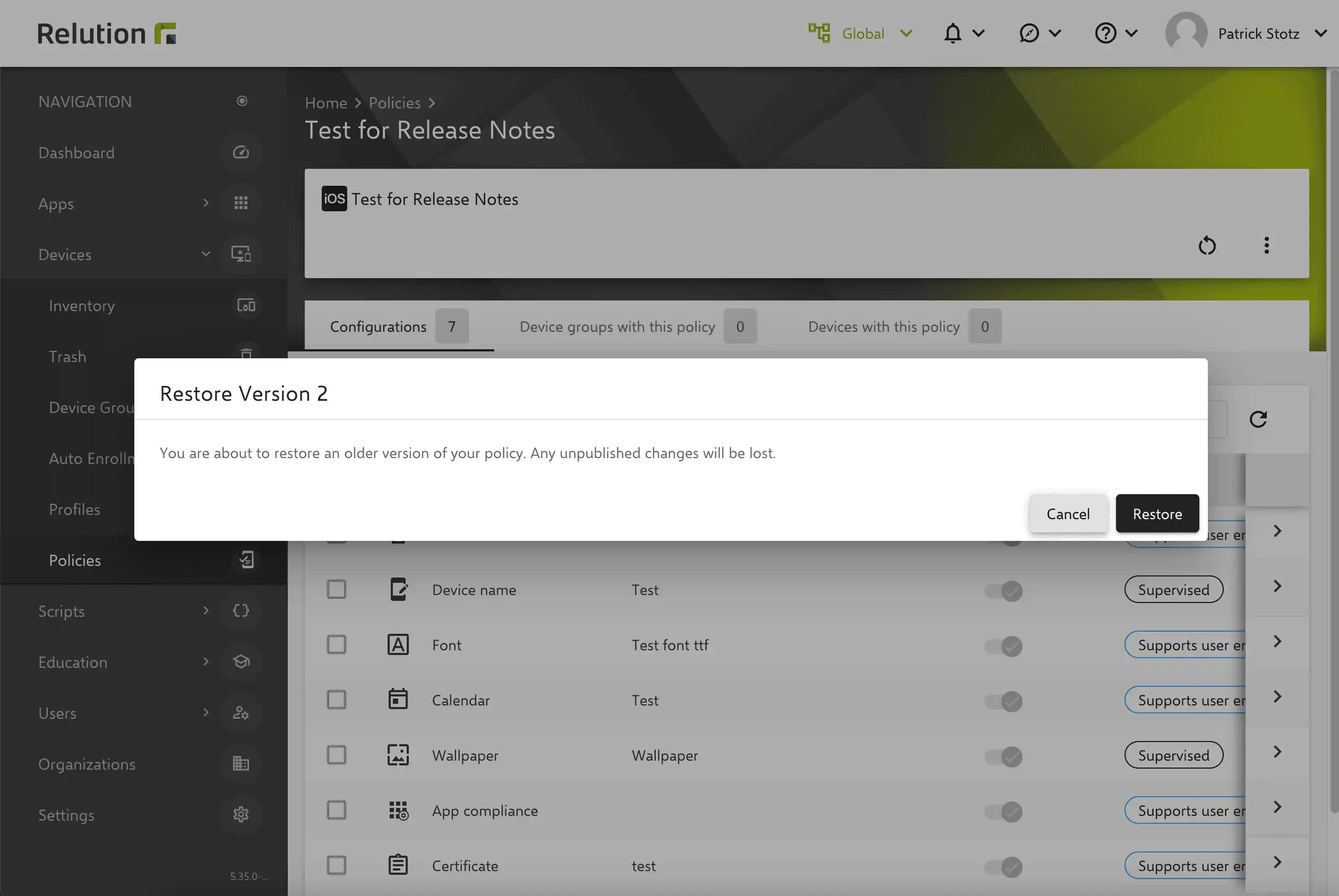
With Relution version 5.35, earlier versions of a policy can be restored in a targeted manner. Previously, it was possible to reset the draft to the last published version. Now, any older version can be used as the basis for the current draft. The draft is completely overwritten with the values of the selected version; unpublished changes are lost. The process must be confirmed before overwriting.
The restoration is performed via a new restore endpoint, which loads the selected version, checks it, and creates it as the current draft version. The name and description remain unchanged so that the version remains clearly identifiable.


Optimized CSV import for classes, auto-enrollments, and Relution Decon requests
With Relution 5.35, the optimization of CSV import is complete. In addition to devices and users, classes, auto-enrollments, and Relution Decon requests can now also be imported.
The import process continues to offer a preview, progress bar, and import summary to make the process transparent. Separators such as commas or semicolons can be adjusted directly without having to re-upload the file.
In addition, an error display and preview function has been added for Decon requests to identify any problems early on and make the import process even more reliable.
Advanced SMTP configuration with global sender address
With this release, the global SMTP email configuration in Relution has been expanded. A new mandatory field, “Sender Address,” must be stored centrally in the global configuration. This stored sender address will be used in the future for all emails sent via the global SMTP service.
Previously, the sender address was automatically taken from the organization through which the email was sent. The new, central configuration makes the sending of emails more reliable, consistent, and fully compatible with common mail servers.
The global email configuration also displays a notification if no valid sender address is stored – in this case, no emails can be sent.
The previous “Email sender” (Email From) field in the notification settings of the sub-organizations has been removed.
The changelog for this release can be found here.
For reasons of better readability, the masculine form is used on this page when referring to persons and personal nouns. In accordance with the principle of equal treatment, the corresponding terms apply to all genders. The abbreviated form is used for editorial reasons only and does not imply any value judgment.